

Imagine Your Ward is about to Graduate Passes All exams and is told he has Fines ranging up to 6million Naira for Mising Bedcheck & Not Going To Church .When School fees Per Session is Already 2.3Million Naira & More ?
Introduction
In 2024
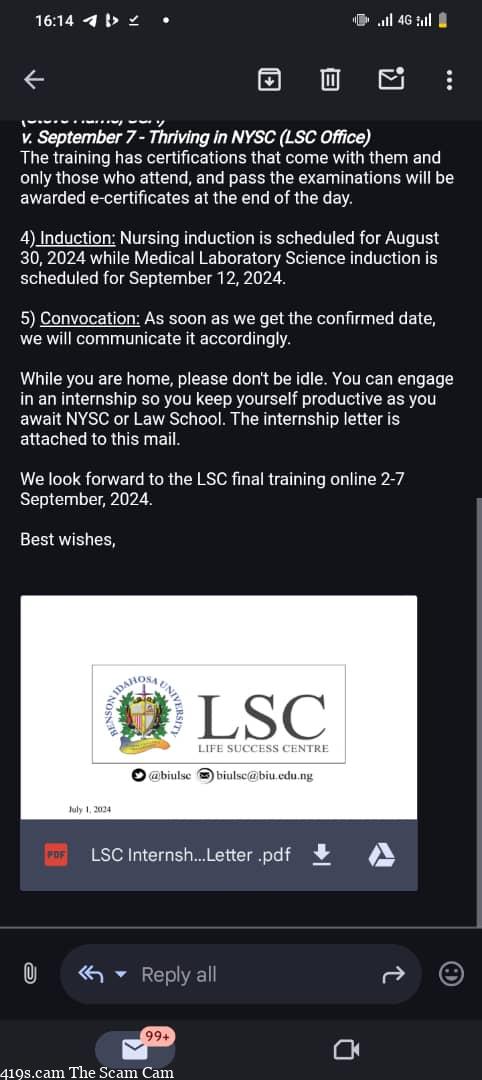
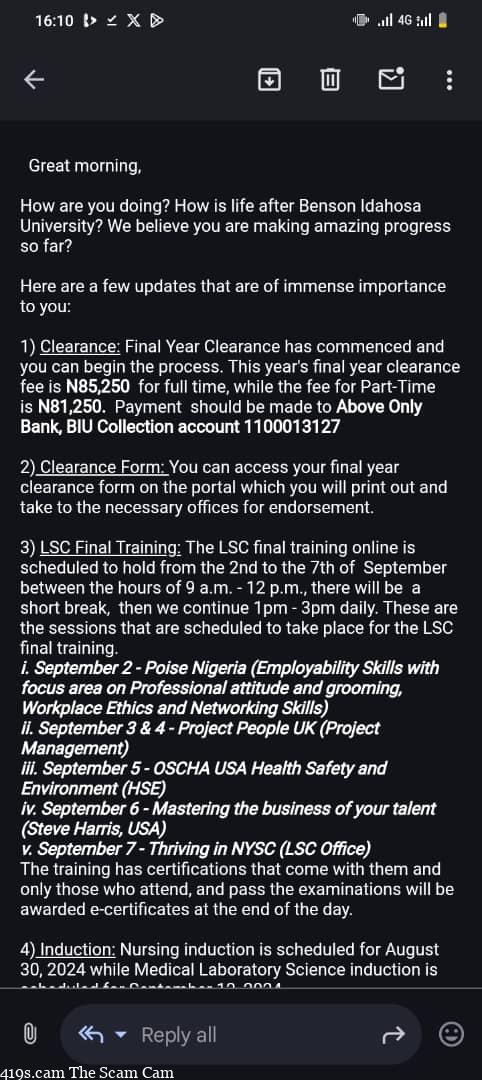
It is becoming a worrisome trend that private universities in Nigeria now grant final clearance to graduated students. Officially, students are advised to pay NGN85,250 (full-time) and NGN81,250 (part-time) into BIU Collection Account Number 1100013127 with Above Only MFB.
The Bank is owned by the school or the church. Outside this official payment, the school charges students an average of NGN400,000 for just clearance. This amount is collected by the CampusLife where you pay for even irregular student signatures. The funniest part is that the management keeps mute over these issues not minding what their staff are doing to the students.
Recent information is that the funds are shared with those “involved”. This is really how private universities (particularly, our church-owned universities), use parents to make money and still feel safe praying to God for the better of the country. How does this kind of wickedness work in a time like this, considering what the average Nigerian is going through? Please, help me as BIU if it is a crime for students to graduate from their institution. An investigation has shown that the Bursary Department cannot clear you if CampusLife does not take their NGN400,000.00.
Bishop Margaret Idahosa” is this the goal? What will this add after the students’ graduation? Are you going to tell the average Nigerians who managed to pay for their wards in your school the reasons for this CampusLife collection? Was the students’ life on rent while in your university? Are they paying for having passed through your university? Is the payment guaranteeing their job future?
Private Christian universities in Nigeria are increasingly becoming known not just for their academic programs but for the staggering financial penalties imposed on students. These institutions, originally established with religious values, have found a lucrative revenue stream in fines, particularly for infractions such as missing bedchecks, skipping religious activities, and breaking arbitrary campus rules.
The irony is that many of these schools claim to uphold Christian principles, yet they operate in ways that seem more like businesses than institutions of faith-based learning. Schools like Benson Idahosa University (BIU) in Benin City, Edo State, and Afe Babalola University (ABUAD) in Ado Ekiti, among others, have turned fines into a multi-million-naira industry, leaving some students with debts ranging from ₦3 million to ₦6 million by the time they graduate.
The Bedcheck Business: A Lucrative Trap
One of the most controversial fines imposed by these universities is for missing bedcheck—a nightly roll call meant to ensure that students are present in their hostels. On the surface, this policy might seem like a simple disciplinary measure, but in reality, it has become a massive financial burden for students.
- Exorbitant Fines: Missing bedcheck can attract fines as high as ₦25,000 to ₦50,000 per night, depending on the university. These fines accumulate quickly, leaving students and their families financially drained.
- Abuse of Power by Prefects & Supervisors: Bedchecks are often conducted by student prefects or school-appointed supervisors who can falsely mark students as absent for personal reasons, power trips, or even out of malice. Some students complain of being fined even when they were in their rooms but missed the roll call due to timing inconsistencies.
- Off-Campus Students Also Targeted: Strangely, even students who live off-campus are not told if they live off campus until they find out before Filling off campus Forms are still fined for missing bedcheck, raising questions about why the school would impose such a rule on non-resident students.
Religious Enforcement: Christianity or Business?
Despite being labeled “Christian universities,” these institutions admit students of all religions, including Muslims, traditionalists, and even former militants undergoing rehabilitation programs sponsored by the Nigerian government. However, once admitted, students are forced to participate in religious activities, whether they share the faith or not.
- Compulsory Church Attendance: Regardless of a student’s faith, attendance at church services and prayer meetings is mandatory. Students who fail to attend are fined heavily, sometimes up to ₦20,000 per missed service.
- No Freedom of Worship: While these universities admit non-Christians, they do not allow students to practice their own religions freely. Muslim students, for instance, often complain about restrictions on their prayers, yet they are forced to join Christian activities.
- Religion as a Financial Weapon: These fines are not just about enforcing discipline—they are a major revenue stream. The fact that students can be forced to pay millions in “religious penalties” contradicts the supposed Christian values of these schools.
Targeting the Rich: The Hidden Admission Strategy
One of the reasons why these universities get away with these financial extortions is because of their deliberate targeting of students from wealthy backgrounds. The tuition fees at these institutions are already extremely high, often ranging between ₦1.5 million and ₦5 million per year, making them accessible mostly to the elite.
- Rich Students, No Resistance: Because most students come from wealthy families, schools assume that parents will simply pay any fine imposed.
- No Financial Aid, Just More Fines: Unlike public universities where students can apply for government scholarships, these private institutions do not offer real financial aid or fee reductions—but they aggressively fine students for every minor infraction.
A Debt Trap: Students Graduate Owing Millions
By the time students complete their four-year programs, many of them owe up to ₦3 million to ₦6 million in fines alone. Some students even end up in legal trouble when they are unable to pay their debts.
- Debt Instead of Degrees: Some students who cannot clear their fines are denied their certificates, effectively ruining their job prospects after graduation.
- Parents Trapped in Endless Payments: Families who have already spent millions on tuition are left with no choice but to keep paying fines to ensure their children graduate.
The Need for Government Regulation & Public Awareness
Private universities in Nigeria, especially those branded as “Christian institutions,” need urgent regulation. Fining students for missing bedcheck or religious services should not be a profit-making venture, and the Nigerian government must step in to stop this financial exploitation.
Until reforms are made, these so-called Christian universities will continue to operate like money-making businesses, trapping students in financial burdens while hiding behind religious principles. If these schools genuinely want to uphold Christian values, then they must prioritize fairness, justice, and true education over financial exploitation.
This post is not targeted at Benson Idahosa University Only but all Nigerian Christian Universities
But We Are Outraged By Complaints .
Bishop Faith Emmanuel Benson Idahosa II, commonly known as Bishop FEB, is a prominent Nigerian minister, educator, and entrepreneur. Born into the esteemed Idahosa family, he is the son of the late Archbishop Benson Idahosa and Archbishop Margaret E. Benson Idahosa. His life’s work spans various sectors, including education, ministry, and business, reflecting a commitment to leadership and societal transformation.
Educational Background
Bishop FEB Idahosa’s academic journey began at Oral Roberts University in Tulsa, Oklahoma, USA, where he earned dual bachelor’s degrees in Biology and Business Administration in 1994. He furthered his education with a Master’s degree in Public Health from George Washington University in Washington, D.C., in 1995. Demonstrating a continuous pursuit of knowledge, he is currently a doctoral candidate in Educational Leadership at Oral Roberts University.
Leadership in Education
Since March 15, 1998, Bishop FEB has served as the President of Benson Idahosa University (BIU) in Benin City, Nigeria. Under his leadership, the university has flourished, emphasizing the development of students’ leadership potential and academic excellence. His contributions to education extend to roles such as proprietor of Nathan American Academy and the Benson Idahosa School of Basic and Applied Studies.
Ministerial Roles
In his ministerial capacity, Bishop FEB serves as the Overseer of Church of God Mission International (CGMi) and is the bishop of the global headquarters church, Faith Arena. He leads the global bishopric of the church and is a member of the CGMi Council of Bishops and its Board of Administration. His ministry focuses on spiritual growth, leadership development, and community service.
Entrepreneurial Ventures
Beyond education and ministry, Bishop FEB is an accomplished entrepreneur. He chairs several companies, including the Above Only Group, Pear Systems Development Company, DFI Nigeria, DFI U.S.A., Rejuvenate Media, and Benson Idahosa Property Development Company. These enterprises operate in various sectors, contributing to economic development within and beyond Nigeria.
Personal Life
Bishop FEB Idahosa is married to Reverend Laurie Whetstone-Idahosa, and together they have three sons: Feb Junior, Nathan, and Judah. He is also an author of six books and a sought-after speaker for church events, leadership conferences, and business seminars. His life exemplifies a blend of humility, vision, and innovation, inspiring many in ministry, business, and education.
Bishop FEB Idahosa’s multifaceted career and dedication to excellence continue to impact various spheres, fostering leadership and transformation in society.